Accounting Constitution · Knowledge Types

The full logic behind your books.

Centinel connects every rule, treatment, exception and workflow to the entities, people and evidence it governs. That is the difference between a lookup table and a system an agent can be trusted with.

Why depth matters

Four layers turn a rule into judgment.

A rule alone breaks on the first novel invoice. With the reasoning behind it, an agent can handle cases it has never seen. With the exceptions, it knows when to stop. With the evidence, your auditor can verify all of it.

Most of this knowledge exists nowhere today—it lives in people’s heads, old emails and call notes. Centinel is the first place it gets written down.

THE RULE
AWS invoices post to 6215 — Cloud InfrastructureThe deterministic mapping. This is where most tools stop.
THE WHY
Cloud-infrastructure vendor; 6215 captures hosting costs under the IT policyThe reasoning that lets agents handle novel cases correctly.
THE EXCEPT
…unless the invoice contains reserved-instance purchases, which are capitalizedEdge cases—where automation historically broke.
THE PROOF
Confirmed by the controller; linked to 186 historical invoicesThe evidence trail your auditor can walk.
The taxonomy

Ten types of knowledge, three jobs.

Everything the Constitution holds does one of three jobs: it encodes judgment, describes how work is applied, or provides the context both depend on.

Judgment

How things should be treated

Classification rulesTransaction attributes → GL account, tax code, cost center, entity.
Reasoning behind rulesThe why—supplier nature, account semantics, policy logic.
Exceptions & edge casesDeviations and the precise conditions that trigger them.
Decisions & evidence trailsJudgment calls recorded with links to invoice, email, approval.
Policies, written & unwrittenThresholds and treatments—documented, or only practiced.
Application

How work gets done

Process & workflow knowledgeHow work actually flows: sequence, tools, handoffs, timing. The blueprint agent workflows are designed from.
Organizational knowledgeWho owns, approves and decides what—roles, permissions, escalation paths. Drives approval routing and permission-gating.
Supplier invoice coding 7 steps · 3 stakeholders · escalation: AP Accountant below 85% confidence, Controller above €50,000
Context

What everything hangs on

Entity & master dataEntities, intercompany links, supplier and customer masters—the structural skeleton every rule hangs on.
Company profilePriors from business model, industry, size and geography that predict expected accounting behavior.
Health & risk insightsDiagnosis of the books and the operation: bottlenecks, risk concentration, hygiene—knowledge Centinel produces, not just collects.
Measured, not asserted

Coverage you can hold to account.

Every knowledge type is scored against the money it governs. Explained means the Constitution can resolve the treatment; confirmed means your team has validated it. The gap between the two is your review queue—ranked by materiality.
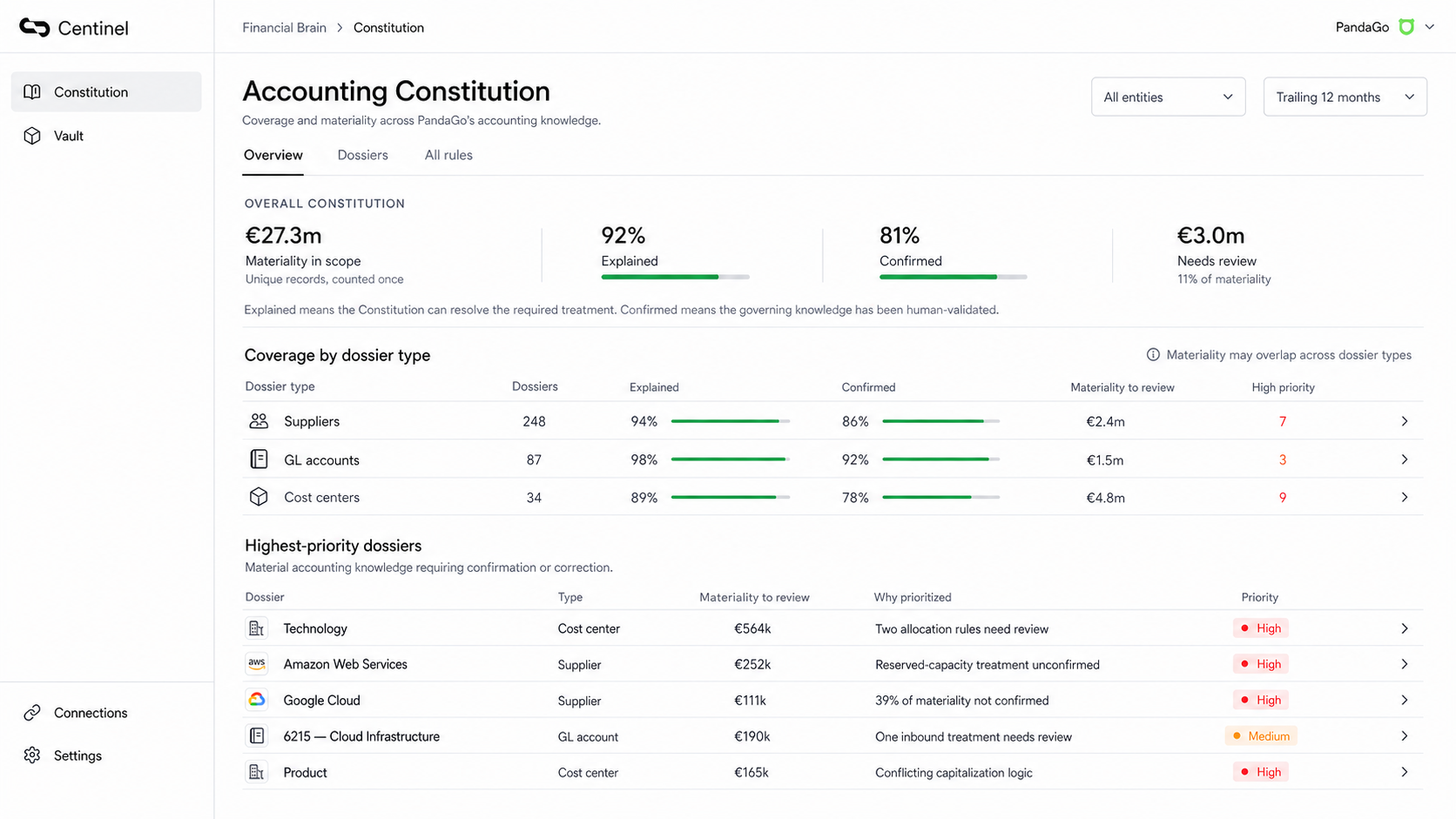
Constitution overview: materiality in scope, explained and confirmed coverage, highest-priority dossiers
Related

Accounting Constitution

The hub: what the Constitution is and powers.

Capture Methods

How knowledge is derived from evidence.

Data Inputs

What evidence enters Centinel.

Most of this has never been written down.

See how Centinel captures it—without a questionnaire.

Capture Methods Book a demo